

When physicist Enrico Fermi was eating lunch with colleagues in 1950, the conversation drifted toward flying saucers and extraterrestrial life. After discussing the staggering number of stars in our galaxy, Fermi reportedly stopped, looked around the table, and asked a question that has puzzled scientists ever since: “Where is everybody?” It sounds simple, almost humorous. Yet more than seventy years later, nobody has a satisfying answer.
The universe is unimaginably old. 13.8 billion years old. It contains more stars than grains of sand on every beach on Earth. We continue discovering planets that appear capable of supporting life. By almost every statistical argument, intelligent civilizations should be everywhere. Yet the night sky remains silent. No visitors. No unmistakable signals. No alien megastructures. Nothing.
That contradiction has become known as the Fermi Paradox, and despite decades of scientific advances, it may be one of the greatest unsolved mysteries in modern science.
The Numbers
Let’s start with why the Fermi Paradox question exists in the first place. Our own Milky Way galaxy alone contains somewhere between 100 and 400 billion stars. Many of those stars have planets. Thousands of confirmed exoplanets have already been discovered, and many orbit within what astronomers call the habitable zone, where temperatures could allow liquid water to exist. Now zoom out. The observable universe contains roughly two trillion galaxies.
Even if intelligent life formed on only a microscopic fraction of those planets, there should still be millions or even billions of civilizations scattered throughout the cosmos. The math doesn’t prove aliens exist. But it certainly makes the idea feel probable.
They’ve Had Time
The age of the universe makes the mystery even stranger. Our Sun formed roughly 4.6 billion years ago. Many stars similar to ours are billions of years older. If intelligent life evolved around even one of those ancient stars, that civilization could have a head start measured not in centuries but in billions of years. Think about what humanity accomplished in just the last century when thinking about the Fermi Paradox.
We went from the Wright brothers flying a few hundred feet…to landing on the Moon…to building global communication networks…to creating artificial intelligence capable of holding conversations. That’s barely a hundred years. Now imagine giving a civilization another 100 million years. Or one billion. The technological difference would be almost impossible for us to comprehend.
Colonizing Galaxies
People often assume galaxies are simply too large to cross. They’re certainly enormous. The Milky Way is roughly 100,000 light-years across. That sounds impossible until astronomers begin running the numbers. A civilization doesn’t need faster than light travel to spread. It only needs patience. Imagine reaching a nearby star, establishing a colony, waiting a few thousand years, then sending another expedition. Repeat the process long enough and the expansion becomes exponential.
Several scientific estimates suggest that even using relatively slow spacecraft, a civilization could spread throughout the Milky Way in only a few million years. That sounds like an eternity. Cosmically? It’s nothing. The galaxy has existed for over 13 billion years. In the Fermi Paradox idea, we should be able to at least see this civilization if it does exist. If just one civilization began expanding long ago…why don’t we see any evidence?
Our Empty Neighborhood
There’s another fascinating detail that often gets overlooked when discussing the Fermi Paradox.
Our Solar System appears to sit within a relatively low density region of the galaxy sometimes referred to as the Local Bubble a cavity in the interstellar medium likely carved out by ancient supernova explosions millions of years ago.
Some people loosely describe this as living inside a “cosmic void,” although that’s not quite the same thing as the enormous galaxy scale voids astronomers study. Even so, our neighborhood is unusually sparse compared to many other parts of the Milky Way. Could that isolation matter? Maybe. Or maybe it’s completely irrelevant. At this point, we simply don’t know.
Where Is Everybody?
This is where the Fermi Paradox becomes fascinating. There isn’t one accepted answer. Instead, scientists, philosophers, astronomers, and engineers have spent decades proposing explanations. Some are hopeful. Some are terrifying. Others suggest we’re asking the wrong question entirely.
Earth Might Be Exceptionally Rare
One possibility is surprisingly simple in the debate of the Fermi Paradox. Maybe intelligent life is extraordinarily difficult to produce. This idea is known as the Rare Earth Hypothesis, championed by astrophysicists and biologists who argue that while microbial life may be common, intelligent civilizations could be incredibly rare. Earth benefited from a remarkable series of fortunate circumstances.
A large moon stabilizes our planet’s tilt. Jupiter likely reduced many incoming impacts by altering the paths of some comets and asteroids, though it’s not a perfect “cosmic shield” in every case. Plate tectonics continually recycle nutrients and help regulate Earth’s climate over geological timescales. We’re positioned within our Sun’s habitable zone. And perhaps most importantly…Life took an astonishingly long time to become intelligent.
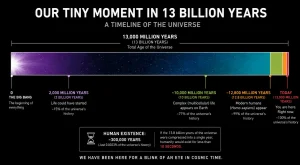
Simple organisms appeared relatively early. Complex multicellular life didn’t dominate until billions of years later. Modern humans have existed for only a tiny fraction of Earth’s history. Maybe intelligence isn’t the inevitable destination of evolution. Maybe it’s an extraordinarily unlikely accident in the Fermi Paradox debate.
Maybe They Already Came and Went
One assumption hidden inside the Fermi Paradox is that alien civilizations should still exist today. But why? Earth itself is roughly 4.5 billion years old, and modern humans have existed for only around 300,000 years. Our entire technological civilization spans just a few hundred years. Compared to cosmic history, humanity is barely a blink of an eye.
Now imagine another civilization that evolved two billion years ago. It could have flourished for millions of years. Built cities on dozens of planets. Spread across thousands of star systems. Perhaps even become a civilization spanning an entire galaxy. Then…It disappeared. Not because it failed immediately. Simply because nothing lasts forever. Stars die. Planets change. Civilizations collapse. Even if an advanced species survived for ten million years, that sounds unimaginably long to us but it’s less than 0.1% of the age of the Milky Way.
Humanity could simply be looking out into the universe after everyone else’s story has already ended. The universe may not be empty. It may simply be late. If civilizations really do disappear, the next question becomes far more unsettling. What killed them? That brings us to one of the most famous ideas in the Fermi Paradox… the Great Filter.
The Great Filter
This is probably the darkest explanation. Economist Robin Hanson popularized the idea of the Great Filter, later explored by philosophers such as Nick Bostrom. The concept is chilling. Somewhere along the path from lifeless rock…to galaxy-spanning civilization…exists an obstacle almost nobody survives. Perhaps developing intelligent life is the difficult step. Or perhaps the dangerous part comes later. Many people suspect the filter still lies ahead of humanity.
As civilizations become more technologically advanced, they also become increasingly capable of destroying themselves. Nuclear war. Engineered pandemics. Runaway artificial intelligence. Climate collapse. Even if you disagree with any individual example, the broader concern remains: technology may advance faster than wisdom. A civilization only needs to fail once.
(And yes… after the past few years, it’s hard not to joke that humanity already had a practice run.)
Space Is Simply Too Difficult
Perhaps aliens exist. Perhaps they’re intelligent. Perhaps they’re even asking the exact same question about us. The problem may simply be physics. Space is unimaginably large. The speed of light the fastest anything can travel isn’t just a suggestion. It’s a hard limit according to everything we’ve observed. Even traveling at 20% of light speed, reaching nearby stars would still take decades or centuries. At those velocities, even tiny grains of dust become extremely energetic impacts, creating major engineering challenges for spacecraft.
The YouTube channel Kurzgesagt – In a Nutshell recently explored concepts like advanced solar sails capable of reaching incredible speeds. Even with futuristic propulsion systems, interstellar travel remains extraordinarily difficult. Communication has the same problem. A message sent to a civilization fifty light-years away wouldn’t receive a reply for at least one hundred years. And that’s assuming anyone was listening.
Alien civilizations may already be broadcasting in this Fermi Paradox debate. Their signals could simply be too weak, too degraded, or too different from anything our instruments are designed to detect. Maybe the universe isn’t silent. Maybe we’re just not hearing it.
We Really Are Alone
Then there’s the explanation many people hope isn’t true in the debate about the Fermi Paradox. Astronomer Michael Hart argued in 1975 that the simplest answer is often the correct one. If advanced civilizations existed…they should already be here. Physicist Frank Tipler expanded this idea by proposing self-replicating robotic probes. Such machines could travel from star to star, building copies of themselves along the way. Given enough time, they could explore the entire Milky Way in what amounts to a brief moment on cosmic timescales.
Yet we’ve found… No probes. No ancient machines. No obvious signs of galaxy wide engineering. Perhaps that’s because there never was anyone else. If Hart and Tipler are right…Humanity isn’t one civilization among many. We may be the only intelligent species this galaxy has ever produced.
The Most Honest Answer
The truth is, nobody knows. That’s what makes the Fermi Paradox so compelling. Every explanation seems plausible. Every explanation has flaws. Perhaps Earth is unbelievably rare. Perhaps civilizations destroy themselves. Perhaps the universe is simply too vast. Perhaps we’re the first.
Or perhaps, somewhere across the darkness, another civilization is staring into its own night sky…wondering exactly the same thing. Where is everybody?
Some even say in the Fermi Paradox debate that the aliens are already here including debates about Nuclear Aliens or the Varginha UFO Incident. Of course these are only conspiracies or theories, but they’re definitely fun to dive into.
Fermi Paradox Final Thoughts
The Fermi Paradox isn’t really a question about aliens. It’s a question about us. It forces us to think about humanity’s future, our place in the universe, and whether intelligence is a common consequence of evolution or an almost impossible miracle. Maybe one day we’ll detect a signal that changes history forever. Maybe we’ll discover microbial life beneath the ice of Europa or Enceladus, proving life isn’t unique to Earth. Or maybe, after centuries of searching, we’ll come to a far stranger conclusion.
The silent cosmos wasn’t waiting for someone else to speak first. It was waiting for us.