
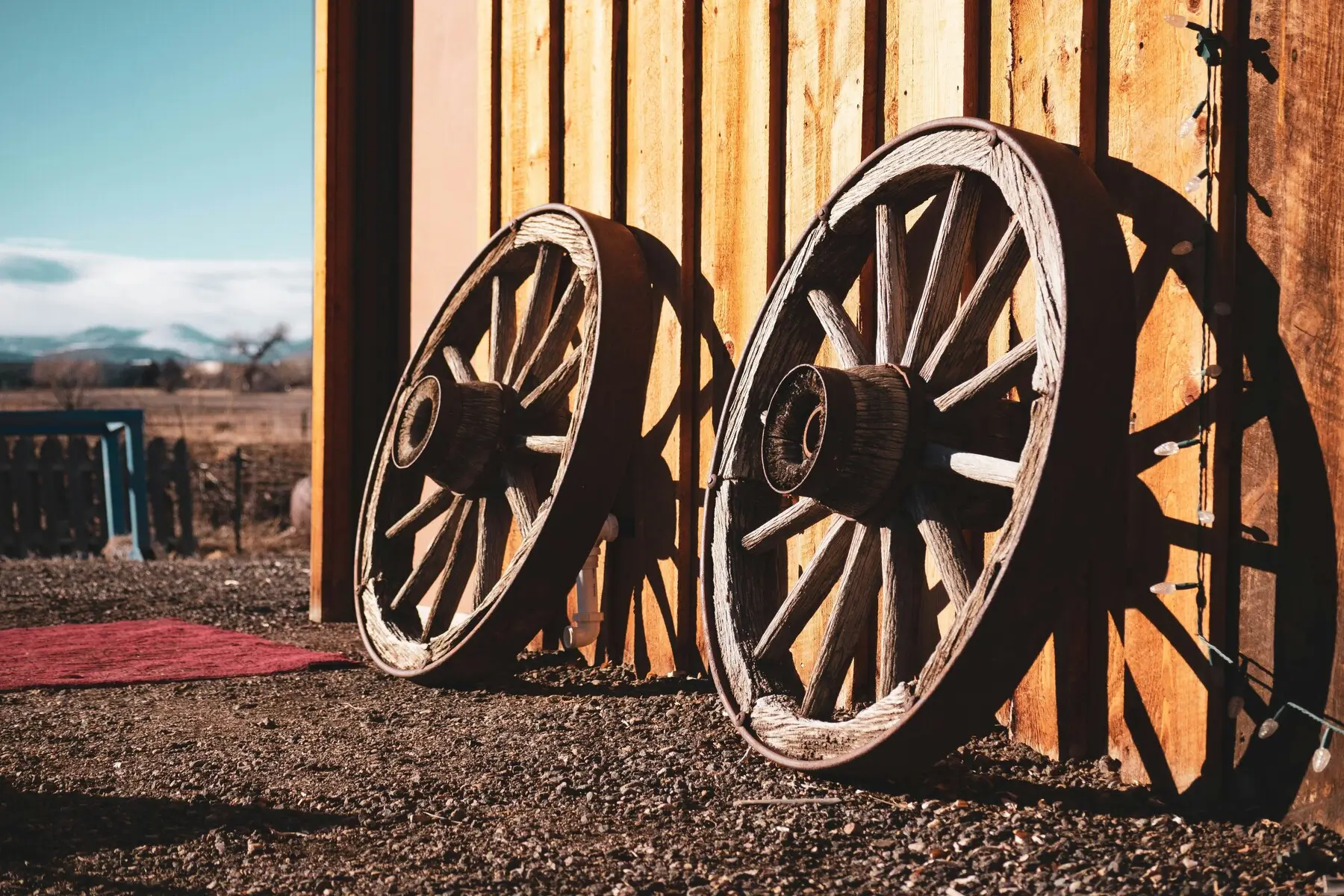
The invention of the wheel is one of humanity’s most significant achievements and marks a pivotal point in the history of human civilization. Here are some key points about its invention:
Origins of the Wheel
- Prehistoric Period: The wheel’s origins date back to ancient Mesopotamia (modern-day Iraq) around 3500 BCE. This region is often credited with the earliest evidence of use.
- Early Wheels: The earliest evidence of them were not used for transportation but for pottery. The potter’s wheel, invented around 3500 BCE, predates the use for carts.
Development:
- Sumerians: The Sumerians are believed to have invented the first wheel for transportation purposes around 3000 BCE. These early inventions were solid wooden discs made from three carved planks clamped together.
- The Sumerians were famous for their early development of wheeled carts and the use of domesticated animals to pull these vehicles. While horses became more prominent in later Mesopotamian civilizations, the Sumerians laid the groundwork for these advancements, contributing significantly to the technological and economic development of their time.
- Axle and Wheel Combination: The breakthrough came with the combination of the wheel and axle. This allowed them to turn while the axle remained stationary, reducing friction and making it easier to move heavy loads.
Spread and Innovation:
- Eurasia: The wheel and axle quickly spread across Eurasia. Evidence of vehicles has been found in Europe, the Caucasus, and China.
- Improvements: Over time, the design improved. Spoked wheels appeared around 2000 BCE, making them lighter and more efficient. This innovation was particularly significant for chariots and other forms of transportation.
Impact:
- Transportation: The wheel revolutionized transportation, enabling the movement of goods and people over long distances more efficiently.
- Essentially without this invention it would be harder to explore, collect, and transport people/materials in the early days when it was difficult exploring new lands.
- Agriculture: It also had a profound impact on agriculture, with wheeled carts and plows increasing productivity.
- Now instead of having 20 different people carry materials and equipment you may have needed one cart.
- Technology and Engineering: The principles behind the wheel and axle laid the groundwork for numerous technological advancements in engineering and mechanics.
- This is probably the biggest upside because with new technology, there is a human effort to better what we created.
The Transition
The transition from the spoked wheel of 2000 BCE to the modern car tire is a fascinating journey of technological innovation and adaptation. Here’s a chronological overview of key developments:
Early Innovations:
- Spoked Wheels (2000 BCE): First invention and innovation in human society around 4000 years before our current existence. This not only laid the groundwork for future work, but it allowed the vehicles we have today to be created. Through treachery, hard work, and genius minds we are able to ride in our current vehicles due to this.
- Metal Rim (1000 BCE): By the first millennium BCE, metal rims began to be used on wheels, providing greater durability and strength.
Middle Ages:
- Iron Reinforcements: During the Middle Ages, wheels began to be reinforced with iron bands. This provided extra strength and durability, essential for the rough terrains of that era.
- Advanced Cart Designs: Carts and wagons with more sophisticated suspension systems and wheel designs emerged, improving the efficiency of land transport.
Renaissance to Industrial Revolution:
- Renaissance Innovations: The Renaissance period saw incremental improvements in wheel technology, including better materials and construction techniques.
- Steam Engines (18th Century): The invention of the steam engine led to the development of early locomotives and railway systems. Train wheels, made of cast iron or steel, were designed to run on tracks, setting the stage for further advancements in the technology.
19th Century:
- Rubber Tires (1845): Scottish inventor Robert William Thomson patented the first pneumatic (air-filled) rubber tire. However, it was not commercially successful at the time.
- John Boyd Dunlop (1888): Dunlop reinvented and popularized the pneumatic tire, primarily for bicycles. This innovation greatly improved comfort and efficiency, and it was soon adapted for automobiles.
Early 20th Century:
- Automobile Industry Boom: The mass production of automobiles in the early 20th century, particularly by Henry Ford’s assembly line, created a demand for better wheels.
- Wire-Spoked Wheels: Early cars often used wire-spoked types, similar to those on bicycles, but stronger to handle the weight of automobiles.
- Solid Rubber and Pneumatic Tires: Solid rubber tires were initially used, but pneumatic tires quickly became the standard due to their superior comfort and performance.
Mid to Late 20th Century:
- Tubeless Tires (1947): The introduction of tubeless tires by B.F. Goodrich improved safety and reliability by eliminating the inner tube.
- Radial Tires (1948): Michelin developed the radial tire, which offered better fuel efficiency, longer tread life, and improved handling compared to bias-ply tires. Radial tires became the standard for passenger vehicles.
- Alloy Wheels (1960s-1970s): Lighter and more stylish alloy wheels became popular, providing better performance and aesthetics.
Modern Developments:
- Advanced Materials: Modern car wheels are made from advanced materials like high-strength steel, aluminum alloys, and carbon fiber, which offer a combination of strength, light weight, and durability.
- Run-Flat Tires: These tires allow a vehicle to continue driving for a short distance after a puncture, enhancing safety.
- Smart Tires: Innovations in sensor technology have led to the development of smart tires that can monitor pressure, temperature, and tread wear, providing real-time data to the driver.
- Sustainable Materials: The automotive industry is increasingly focusing on sustainability, with research into tires made from renewable and recycled materials.
Without Innovation
The invention is widely regarded as one of the most transformative and impactful inventions in human history. Its absence would have significantly altered the course of technological and social development. For example, without the innovation we would have issues in transportation, trade, agriculture, urbanization, infrastructure, technological advancements, military, defense, cultural, and society.
Transportation of goods and people would have been much slower and more labor-intensive. This would have severely limited trade, communication, and the movement of populations. The efficient movement of goods is a cornerstone of economic growth. Without these vehicles, economies would have developed more slowly, and trade networks would have been less extensive.
Carts and plows have greatly increased agricultural productivity. Without them, farming would have remained more labor-intensive, limiting food production and population growth. The ability to transport large quantities of agricultural produce efficiently has been crucial for feeding growing populations and preventing famines. Especially in the older ages where traveling was more difficult and dangerous.
The development of cities and complex societies relies on the efficient transportation of resources. Without vehicles, urbanization would have been slower, and cities might have remained smaller and less complex. Roads, bridges, and other infrastructure developments were driven by the need to accommodate wheeled vehicles. Without them, infrastructure would have evolved differently and likely less efficiently.
The wheel and axle are fundamental principles in many mechanical devices. Without them, numerous other technological advancements, from machinery to transportation technologies like trains and cars, would have been delayed or taken different forms. The principles of the invention have underpinned much of engineering and mechanical design. The absence of this foundational technology would have constrained the development of complex machines and devices.
The use of chariots and later vehicles has been crucial in the development of military strategies and tactics. Without them, armies would have been less mobile, and warfare would have evolved differently.
The ability to travel and trade facilitated cultural exchange and the spread of ideas, technologies, and innovations. Without them, societies might have remained more isolated. Everyday life, including tasks like transporting water, goods, and people, would have been more arduous and time-consuming without the invention.
Summary
The evolution from spoked wheels to modern car tires reflects continuous advancements in materials science, engineering, and manufacturing processes. Each innovation has contributed to improving performance, safety, and efficiency, shaping the tires we rely on today. The invention showcases human ingenuity and the ability to solve practical problems, leading to profound changes in society and the world.
The wheel has played a crucial role in shaping human civilization. Its absence would have profoundly affected transportation, agriculture, economic development, urbanization, technological progress, and cultural exchange. While humanity would have undoubtedly found alternative solutions and technologies, the pace and nature of development would have been markedly different, likely resulting in a slower advancement of civilization and a lower overall quality of life.