
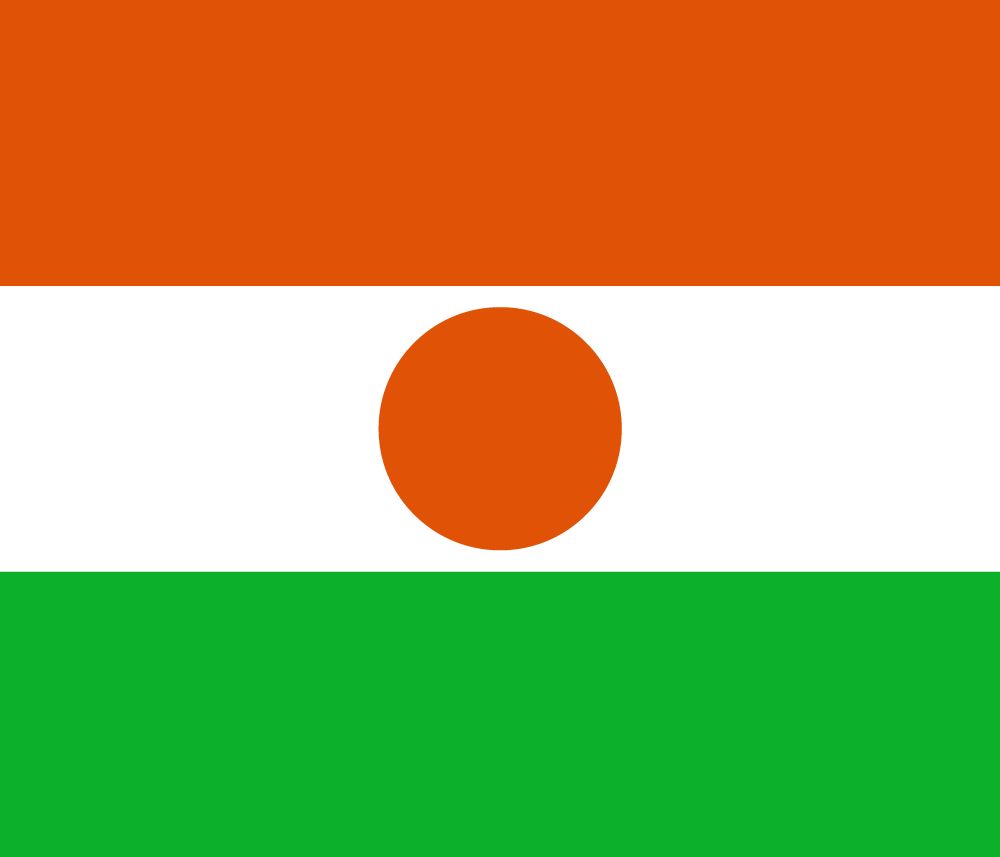
Niger, officially known as the Republic of Niger, is a landlocked country located in West Africa. It is bordered by several countries, including Algeria to the north, Libya to the northeast, Chad to the east, Nigeria and Benin to the south, Burkina Faso to the southwest, and Mali to the west. The country derives its name from the Niger River, which flows through the southwestern part of the country.
Key facts:
- Capital: Niamey
- Population: Predominantly Muslim and consists of various ethnic groups.
- Language: The official language is French, and there are also numerous indigenous languages spoken throughout the country.
- Economy: Based on agriculture, with subsistence farming being a major livelihood for a large portion of the population. The country also has significant uranium reserves, which play a crucial role in its economy.
- Natural Resources: In addition to uranium, Niger has other mineral resources like coal, gold, and oil, although these sectors are less developed.
- Challenges: Related to poverty, desertification, food security, and limited access to education and healthcare. It ranks among the world’s least developed countries.
- Geography: Landscape is covered by the Sahara Desert, which makes up a large portion of its territory. The southern regions are more fertile and are suitable for agriculture.
- History: Ancient kingdoms and empires once existing in the region. In the modern era, it was a French colony until it gained independence in 1960.
Niger is often associated with challenges such as food insecurity, droughts, and desertification due to its location in the Sahel region, which is susceptible to these issues. Efforts have been made by the government and various international organizations to address these challenges and improve the living conditions of its people.
Niger Coup in July
High ranking military officials in Niger decided to overthrow the regime run by the president of Niger known as Mohamed Bazoum. They arrested the current president who was elected into office in 2021. The ranking military officials also call themselves the Junta (Hunta) which is defined as the national council for the safeguard of the homeland. Nations around the world were extremely unhappy with the coup event condemning the actions of the military officials.
Additional issues arise as America and France have a hand in Niger as a country in Africa. Both the United States and France have significant associations with Niger, which range from historical, political, economic, and security-related interactions. Here’s a brief overview of their relationships with Niger:
France:
- Colonial History: Once a French colony and was part of French West Africa. It gained its independence from France in 1960. As a result of its colonial history, Niger maintains cultural, linguistic, and economic ties with France.
- Economic Relations: France has maintained economic relations with Niger, with various French companies involved in sectors such as mining (especially uranium), infrastructure, and telecommunications.
- Development and Aid: France has provided development assistance to Niger in areas such as education, health, and agriculture. This includes support for projects aimed at improving food security, healthcare access, and education.
- Security Cooperation: France has engaged in security cooperation with Niger, especially in the context of counterterrorism efforts in the Sahel region. It is part of the G5 Sahel group, which aims to address security challenges in the Sahel through joint efforts.
United States:
- Security and Counterterrorism: The United States has engaged with Niger in security and counterterrorism efforts, particularly as part of broader regional initiatives in the Sahel. The U.S. has provided training, equipment, and support to the security forces to counter extremist groups and maintain stability.
- Humanitarian Assistance: The U.S. has provided humanitarian aid to Niger to address issues such as food security, health, and education. This includes assistance during times of drought and food crises.
- Economic Engagement: The U.S. has been involved in various economic development projects in Niger, focusing on sectors like agriculture, health, and education. USAID, the United States Agency for International Development, has supported programs aimed at improving livelihoods and reducing poverty.
- Peacekeeping and Diplomacy: The U.S. has supported diplomatic efforts and peacekeeping initiatives in the region, working with Niger and other countries to address conflicts and security challenges.
Both France and the United States have interests in promoting stability, development, and security in Niger and the broader Sahel region due to the potential impact of regional instability on global security and humanitarian concerns. Their engagements are often part of larger international efforts involving multiple countries and organizations to address the multifaceted challenges faced by Niger and the Sahel.
More concerns occur with the fact that the current citizens of Niger who support the coup also support Russia becoming more involved with the country. They essentially want to kick out France and America with the replacement of Russia as the foreign power in the region. The countries surrounding Niger have also pledged they may have military intervention involvement to reinstate the old president who was essentially kicked out of his role. The Wagner Group also has ties to many African countries and has a potential to be a large player in its current coup.
Reasons for the Coup
Some of the main reasons there was unrest in Niger was due to the fact that the people are still suffering in the country. Rising costs of living, corruption, and government incompetence are some of the main issues people have with their government which was led by president Mohamed Bazoum. He also was trying to cut the salaries of the military officials due to having an extreme amount of distrust from the military. The coup leaders have also stated they will prosecute the president for high treason for undermining internal and external securities of Niger.
Niger, like many countries, has experienced varying levels of trust and distrust in its government over time, influenced by a range of factors. Public opinion can be complex and diverse, and not all citizens may share the same views. However, there are some common factors that have contributed to distrust in the government among some Niger citizens:
- Political Instability: Niger has faced political instability throughout its history, including military coups and changes in government. These incidents can erode public trust in political institutions and leaders.
- Corruption: Corruption has been a significant issue with allegations of embezzlement, bribery, and misuse of public funds. When citizens perceive that government officials are corrupt, it can lead to a lack of confidence in the government’s ability to address the needs of the population fairly and effectively.
- Poor Service Delivery: Limited access to basic services such as healthcare, education, and infrastructure can contribute to public dissatisfaction with the government. If citizens feel that the government is not adequately addressing their needs, it can lead to a sense of distrust.
- Economic Challenges: High levels of poverty and unemployment can contribute to frustration and disillusionment with the government’s economic policies and its ability to improve the overall well-being of the population.
- Ethnic and Regional Divisions: Home to diverse ethnic and regional groups, and sometimes government policies are perceived as favoring one group over another. This can lead to a sense of exclusion and distrust among marginalized communities.
- Security Concerns: Including the threat of extremist groups operating in the Sahel region. If citizens feel that the government is unable to adequately address security issues and protect them, it can lead to distrust in the government’s ability to ensure their safety.
- Political Repression: Instances of political repression, restrictions on freedom of expression, and human rights abuses can undermine trust in the government’s commitment to democratic values and the rule of law.
Trust in government is a complex issue influenced by a combination of historical, cultural, economic, and political factors. Some citizens may indeed distrust the government due to the reasons mentioned above, while others may have more positive perceptions based on their own experiences and perspectives. Efforts to build trust in government involve addressing these underlying issues and working towards greater transparency, accountability, and responsive governance.
What Now
The current newest information surround the coup includes the fact that the new military leader General Abdourahamane Tchiani has proposed a return to democracy within 3 years of the coup. The Junta want to rebuild the west African country into a better world stated by their own military leaders. They stated they don’t necessarily want war and want to remain open to discussions with foreign powers. Additionally ECOWAS has enacted sanctions on the country causing Nigeria to cut the majority of the power to Niger which accounted for about 70% of their total supply.
It remains unknown whether or not the other countries in the region are going to invade to restore power to the past president. The issue with this is that if other countries get involved with reinstating the power it causes the president to lose legitimacy even if he is reintroduced. There have been more problems considering Mali and Burkina Faso have stated they would consider invasion of Niger as an invasion to themselves. Nigeria would easily be able to defeat the coup as they have one of the strongest militaries in the region. However, simply defeating the coup might cause additional problems as invading another country and instilling the power you want doesn’t really go well with the citizens of that country with a perfect exampling including Afghanistan.
- Niger’s Political Landscape and Governance:
The aftermath of the coup in Niger leads to a period of political uncertainty. The Junta, the group of military officials who orchestrated the coup, might establish an interim government to oversee the country’s affairs. This interim government could face challenges in gaining international recognition and legitimacy, as coup events are often frowned upon by the international community.
- International Reactions:
The international community, including nations like the United States and France, condemns the coup and calls for a return to constitutional order. Diplomatic pressure is exerted on the Junta to restore the previous elected president or hold democratic elections to determine the country’s leadership. The United Nations and regional organizations like the African Union could also play a role in mediating the situation.
- Civil Society and Public Reaction:
Niger’s citizens may have mixed reactions to the coup. While some may support the Junta’s actions due to frustration with the previous government’s perceived corruption and mismanagement, others might be concerned about the implications for democratic governance and stability. Civil society organizations, activists, and ordinary citizens might engage in protests and advocacy for a peaceful and democratic resolution to the crisis.
- Potential Russian Involvement:
The desire by some citizens to see Russia become more involved could result in attempts to establish new diplomatic and economic ties. However, Russia’s involvement might not be straightforward, as the international community closely watches any foreign intervention. The extent of Russian influence could depend on factors such as economic agreements, military support, and geopolitical interests.
- Regional Involvement and Conflict Resolution:
Neighboring countries, concerned about instability spilling over into their territories, may collaborate to find a solution. The Economic Community of West African States (ECOWAS) and other regional organizations could mediate negotiations between the Junta and various stakeholders to ensure a peaceful transition back to civilian rule. Military intervention, as pledged by some neighboring countries, remains a last resort option. There is also potential for ECOWAS involving themselves militarily in this situation with the theoretical help from Nigeria if they agree to it.
- Reforms and Reconciliation:
To regain trust and address the reasons for the coup, the interim government or elected leadership might initiate a series of reforms. These reforms could focus on anti-corruption measures, improving service delivery, promoting economic development, and strengthening democratic institutions. A national reconciliation process could also be launched to heal divisions within society.
- International Support for Stability:
International partners, such as the United States, France, and other countries, could offer support for Niger’s stability and development. This might include providing aid for humanitarian assistance, economic development projects, security sector reform, and capacity-building initiatives to strengthen governance institutions.
- Transition to Democratic Governance:
Through negotiations, elections, or a combination of both, Niger could eventually transition back to democratic governance. The process would likely involve multiple stakeholders, including political parties, civil society organizations, and citizens. The outcome would ideally be a government that addresses the concerns of the population and works towards sustainable development and stability.
About ECOWAS
ECOWAS stands for the Economic Community of West African States. It is a regional intergovernmental organization in West Africa that was established with the goal of promoting economic integration, cooperation, and development among its member states. ECOWAS was founded on May 28, 1975, with the signing of the Treaty of Lagos.
The organization’s primary aim is to foster closer economic and political ties among its member countries in order to enhance the overall well-being and development of the region. ECOWAS seeks to achieve these goals through various means, including:
- Economic Integration: ECOWAS aims to create a single, large market and economic space within the region by removing trade barriers, harmonizing economic policies, and facilitating the movement of goods, services, and people among member states. The organization has worked towards establishing a common external tariff and liberalizing trade among its members.
- Regional Cooperation: ECOWAS promotes cooperation among member states in various sectors such as agriculture, industry, energy, transportation, and telecommunications. Collaborative efforts are aimed at achieving economies of scale, sharing resources, and addressing common challenges.
- Peace and Security: ECOWAS has played a significant role in conflict resolution and peacekeeping within the region. The organization has been involved in mediating political disputes, deploying peacekeeping forces, and facilitating negotiations to maintain stability and prevent conflicts.
- Human Development: ECOWAS is committed to improving the quality of life for people in the region. It focuses on areas such as health, education, social welfare, and the environment to promote sustainable development and human well-being.
- Promotion of Democracy: ECOWAS places importance on democratic governance and the rule of law. The organization has taken steps to support democratic transitions, promote free and fair elections, and condemn unconstitutional changes of government.
ECOWAS is composed of 15 member states in West Africa, including Benin, Burkina Faso, Cape Verde, Ivory Coast, Ghana, Guinea, Guinea-Bissau, Liberia, Mali, Niger, Nigeria, Senegal, Sierra Leone, Togo, and The Gambia. The organization is headquartered in Abuja, Nigeria, and its activities are guided by various organs, including the Authority of Heads of State and Government, the Council of Ministers, the Commission, and specialized agencies and institutions.
Through its efforts to foster regional integration and cooperation, ECOWAS seeks to create a more unified, prosperous, and stable West African region.
Conclusion
Niger’s intricate geopolitical landscape and historical context have shaped its trajectory, marked by challenges and aspirations. Situated in West Africa, the nation bears the weight of a complex history, encompassing ancient empires and colonial legacy. It is a country rich in resources, from its vast uranium reserves to its cultural diversity and fertile southern regions.
Yet, Niger also grapples with a multitude of hardships. Struggles with poverty, desertification, and food security have tested the resilience of its citizens. These issues are further compounded by political instability, corruption, and distrust in government institutions. While some may view the recent coup as a response to these grievances, it has prompted international concern and calls for a return to democratic order.
Key global players, notably France and the United States, have deeply intertwined relationships with Niger. These interactions span economic partnerships, security collaborations, and developmental aid, underscoring their commitment to stability and progress in the Sahel region.
A new dynamic emerges as some voices within Niger advocate for a shift in foreign affiliations, seeking a prominent role for Russia while expressing dissatisfaction with the prior influences. The intricate web of interests among international actors adds complexity to the situation.
As the nation navigates the uncertain aftermath of the coup, the path forward remains convoluted. Reconciliation, reform, and transparent governance are imperative to rebuild public trust, promote stability, and address the pressing challenges that have plagued Niger for years. The future hinges on the collective efforts of Niger’s citizens, its neighbors, and the international community, as they strive to steer the nation towards a more prosperous and secure future.