
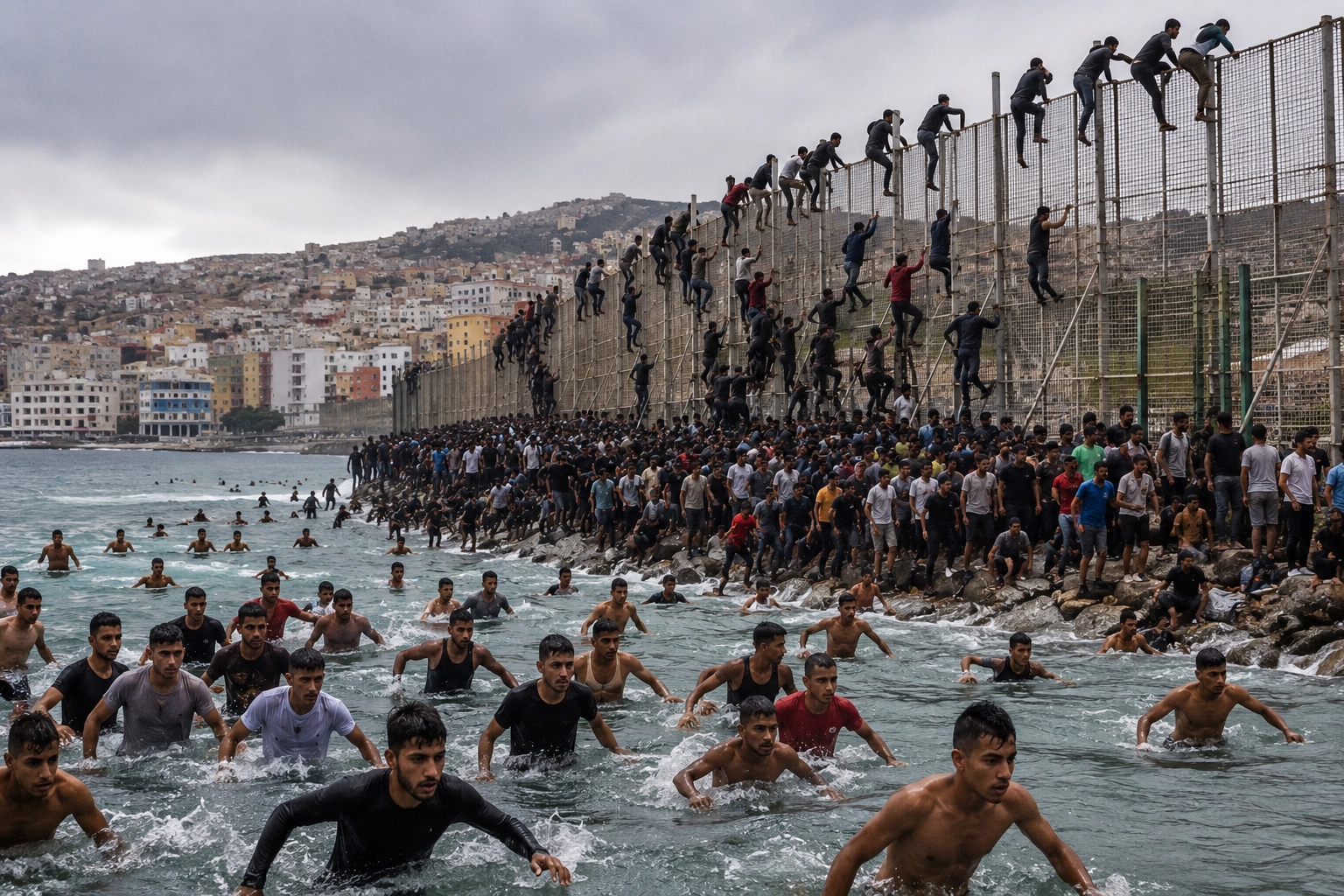
Ceuta is one of Spain’s cities and nearly 60,000 Moroccan migrants crossed the borders in just a matter of days. It isn’t just another immigration story, but one of the largest sudden migration events in Europe in recent memory. It overwhelmed the city of Ceuta which housed an approximate 84,000 residents. As the humanitarian crisis unfolded, another conversation exploded online. Was this simply due to economic hardship in Morocco or is there something much larger happening behind the scenes? Let’s look at both the facts and theories.
Ceuta Overwhelmed
It is a unique place in the northernmost part of Africa belonging to Spain for centuries representing one of Europe’s only land border with Africa. In Late July 2026, that border was effectively overwhelmed with estimates suggesting 60,000 Moroccans entered the city of Ceuta. Many by swimming around border barriers or crossing shallow coastal waters. The influx of these migrants equaled nearly 70% of the total population in the city of Ceuta.
Spanish authorities rapidly deployed military personnel while thousands were eventually returned to Morocco. The event alos turned tragic with dozens of reported deaths during the crossings. Mostly due to drowning and trampling. For residents of the Ceuta the crisis wasn’t an abstract political debate, it was happening on their front doors.
National Emergency
One of the biggest questions the residents and online outlets have is why didn’t Spain declare this a formal national emergency. The president of Ceuta requested emergency powers arguing the city of Ceuta had lost control of the situation. However, Madrid instead chose to reinforce security forces without invoking Spain’s highest emergency framework.
Legally, Spain argued that it’s emergency declaration system is primarily designed for disasters such as earthquakes, floods, and industrial accidents. Not sudden migration events. To critics this explanation felt like politics over practicality.
Did Morocco Allow This?
Perhaps the biggest factual question isn’t whether migrants wanted to leave Morocco, it is whether Moroccan officials allowed the crossing. There is historical precedent here. During previous diplomatic disputes with Spain, Morocco has been accused of easing border enforcement to increase political pressure. Witnesses during this crisis similarly reported periods where the Moroccan security appeared to do little to stop people before enforcement later intensified.
Whether that was deliberate political decision or simply an overwhelmed security response remains an open question. Either way, the event reminded Europe just how much influence Morocco possesses over one of it’s most sensitive borders.
Facts from Theories
Several facts are well established. A massive migration event occurred in Ceuta. Morocco and Israel have significantly expanded diplomatic and military cooperation in recent years. A published opinion piece encouraged Israel to help Morocco to pursue its claims over Ceuta and Melilla. Everything beyond that enters the realm of speculation.
Could Morocco have used migration as political leverage? History suggests it is a possibility that’s worth exploring. Did Israel and the United States coordinate the migration itself? There is currently no credible evidence demonstrating that. In today’s information age, separating verified facts from compelling narratives is becoming increasingly difficult. Sometimes conspiracies turn out to be true. Many others never move beyond circumstantial timing and geopolitical suspicion.
For now, the Ceuta crisis remains both a humanitarian emergency and a geopolitical mystery. One where the facts tell a fascinating story even before the speculation begins. ]
Good News
The good news is that the immediate crisis appears to be easing. Spanish authorities estimate that more than 48,000 of the roughly 60,000 migrants who entered Ceuta have already returned to Morocco either voluntarily or through coordinated efforts between the two governments. Spain has reinforced the border with military personnel while Morocco has tightened security on it’s side, significantly slowing new crossings.
That doesn’t mean the underlying problem has been solved.
The economic conditions that pushed many Moroccans toward Europe still exist. The political dispute surrounding Ceuta and Melilla hasn’t gone away. Perhaps most importantly, questions remain about why the border appeared to become so porous in the first place. Whether this was simply a perfect storm of economic desperation, social media rumors, and overwhelmed border security or a calculated geopolitical pressure campaign is something that will likely continue to be debated long after the last migrant has returned home.
One thing is certain. Ceuta crisis has become far more than an immigration story. It has evolved into a test of European border security, Spain’s relationship with Morocco, and a reminder that in today’s geopolitical landscape, migration can be both a humanitarian tragedy and a powerful political tool.
Israel and US Conspiracy
This is where the story we are writing becomes a slight bit more controversial.
Months before the migration crisis, Ynet News published an opinion article by an analyst Amine Ayoub arguing that Israel should use it’s growing relationship with Morocco under the Abraham Accords to diplomatically support Morocco’s claim over Ceuta and Melilla. The article argued that Israel’s influence in Washington and its close partnership with Morocco could help Rabat strengthen its territorial ambitions.
After the migration crisis occurred, many online personalities began asking whether the article had foreshadowed something much larger. Some theories claim Israel quietly encouraged Morocco to pressure Spain because of Spain’s criticism of Israeli policy in Gaza.
Others take the theory even further, alleging the United States of America or the CIA supported the effort to weaken Spain’s government while simultaneously highlighting Europe’s immigration challenges. At this point, there is no publicly available evidence supporting either of those claims. The existence of an opinion article advocating diplomatic support for Morocco does not demonstrate coordination between governments or intelligence agencies. Still, the timing has fueled speculation across social media. Some even compare this incident with the United States border crisis from 2020 to 2024.