How is China viewed globally:
- Largest exporter
- Worldwide trader
- Vast population size
- Massive military
- Communist and authoritarian government
- Skyrocketing economic growth
- Number two superpower of the world
China appears to be in an advantageous position on the global and local scale. The history of China has been filled with constant struggle between political parties, famine, and widespread poverty. With the country’s current position economically it seems as if China is doing better than decades prior to its current era. Here lies the question of whether China is going to be the number one superpower of the world or if the country is going to nosedive back into hardship. It’s genuinely a difficult question to ask as not all the information obtained from the country can be considered legitimate. Certain examples include the fact that they will stop sharing their COVID data with the world, refused scientists to enter the Wuhan lab without close supervision, and terrorized it’s citizens with zero-Covid lockdowns. Lets break into the ice with what might be contributing factors to its potential demise.
What are problems affecting China today?
Growth at such a high magnitude in China comes with consequences that we can see in today’s age. Let’s dig into the issues to see what problems the country is facing:
- Heavy urbanization move caused by industrialized job growth
- One-Child policy enacted in 1980 due to rapid population growth
- Mortgage crises caused by a housing Ponzi-scheme
- Zero-COVID strategy led by government leaders
- Honorable mentions
1. Heavy Urbanization
In the late 1970’s and early 1980’s China began to have an economic revolution that would change them forever. It included a turn in power involving the death of Chairman Mao in 1976 and the rise of Deng Xiaoping. These changes allowed the world we know today to be created. Deng Xiaoping began economic reforms allowing the communist authoritarian regime to open up trade to the rest of the world and allowed the citizens of China more control to start companies. Before this period the government essentially decided who would work in certain areas and how much everyone should produce. Focusing minimally on exports and imports as the government decided they wanted to be self-sufficient. There used to be zero reason to go above and beyond their capabilities as nothing was rewarded above the goal set.
After the free-market reforms in 1979 and onward, China began to grow exponentially as a country. They had one of the fastest growing economies that ever existed in this day and age. Due to privatization of work, labor, and the market allowing companies to take charge instead of relying solely on the government. In a sense Mao’s leadership caused a bottleneck of goods, services, and agriculture as the centralized government could not expand fast enough for its population growth. Agriculture also had recent technological advances and reforms by the 1980’s meaning the country no longer needed so many workers in the agricultural sector.
Heavy urbanization over the course of decades caused China to lose a lot of its rural populations. Many farmers and rural citizens are becoming left behind in the dust in the vast country. This is because many citizens of the country were driven to urban cities to make money for their families. Initially it would be a temporary change, but many of them found that they liked to live in the urban environments. In this case due to heavy urbanization entire communities in the rural parts of China are slowly dying off.
- In 1980 around 19.4% lived in urban cities or 191 million people
- In 2010 around 50% lived in urban cities or 622 million people
- In 2021 around 64.7% lived in urban cities or 906 million people
The reason this lead to massive issues in the country is linked mostly to the one-child policy enacted by the government in 1980. Men were the preferred children to have during this period mostly because the parents wanted somebody to take care of them. Women were mostly married off and lost to their original families which would cause parents to pick men in most circumstances. Men were also able to earn more income, continued the family blood line, and had the responsibility to take care of their parents. With this topic at hand which is a perfect Segway, let’s get into the number two problem that China is encountering.
2. One-Child Policy
Around the same time as the heavy urbanization, economic reform, and political policy change they approached and landed on the 1 billion people mark causing the leaders to begin questioning their growth. In 1980 the one-child policy was enacted to help curb the massive population growth the country experienced. The policy was created mostly due to fears of what may happen to the economy and welfare systems. They believed at the time that overpopulation could potentially ruin the systems that were in place and cause massive unrest from straining the overall goods, services, and food supplies. However, the issues rose very quickly because the population had already been declining after the 1960’s. There is a certain standard in every country called the replacement rate. This needs to be held at around 2.1 children for every family to continue allowing for growth on the population pyramid. Once there is a dip or loss under the 2.1 threshold it means there will be an inevitable loss of people as time goes on. In the 2010 China census it appeared that the fertility in their country was at a measly rate of 1.1 to 1.2.
Understanding the replacement fertility rate is important to understand why it’s an issue. The known number is 2.1 which is required to account for possible deaths due to childbirth, loss of early life, or unforeseen circumstances. In 2022, China experienced its first decline of the population since the great famine which happened at the end of the 1950’s and early 1960’s. China lost 850,000 people from the previous year showing a drastic change which may continue to affect Chinese citizens. Many of these effects are caused by the one-child policy which was mentioned briefly in the heavy urbanization area above. Lack of wanting females during the one-child policy caused massive problems in China. Easy attributions of this problem can be linked to less marriages, less children, and an imbalance of 30 million more men than women. Added onto these issues there is a high abortion rate, a huge aging population, difficulty in raising children, difficulty in finding a home near a good school, and the rising issues of costs in urban cities. Lastly, another major issue for women in China is the horrible treatment of women in marriages as companies don’t want to hire somebody who could potentially be on maternity leave. Here is a quick rundown of some the major issues:
- Sex-selective abortions preferring males increased during the one-child policy
- Increased imbalance of men to women ratio continues to exist
- Marriages and fertility has been steadily dropping
- High abortion rate exists ranging from 9-15 million abortions annually
- Aging population causes major issues in the workforce and dependence on the youth
- Costly schools and homes are deterring women from having children
- Child-bearing women are thought of negatively in the workforce
Recently, in 2016 the Chinese government stated that families are allowed to have two children per household. Then in 2021 a three child policy was announced and many of the restrictions or limitations have been removed entirely. However, this seems like a half-baked effort for the current problem they are facing. It seems the ruling from the 1980’s has had extremely devastating effects on the country overall. It took decades for the one-child policy to cause the ramifications we see today so this new policy could also take decades to have any sort of return. The main issues are that the world is different from how it was 40 years ago. Many things have changed and the new urbanization China experienced may cause women to no longer yearn to have children. There is a multitude of problems that are affecting the country today which may hurt the population’s morale. From higher costs to an authoritarian regime a large part of the Chinese citizens are struggling to make ends-meat. Time to get into the horrible housing market Chinese property developers have created which can lead the economy to ruin.
3. Chinese Mortgage and Housing Crisis
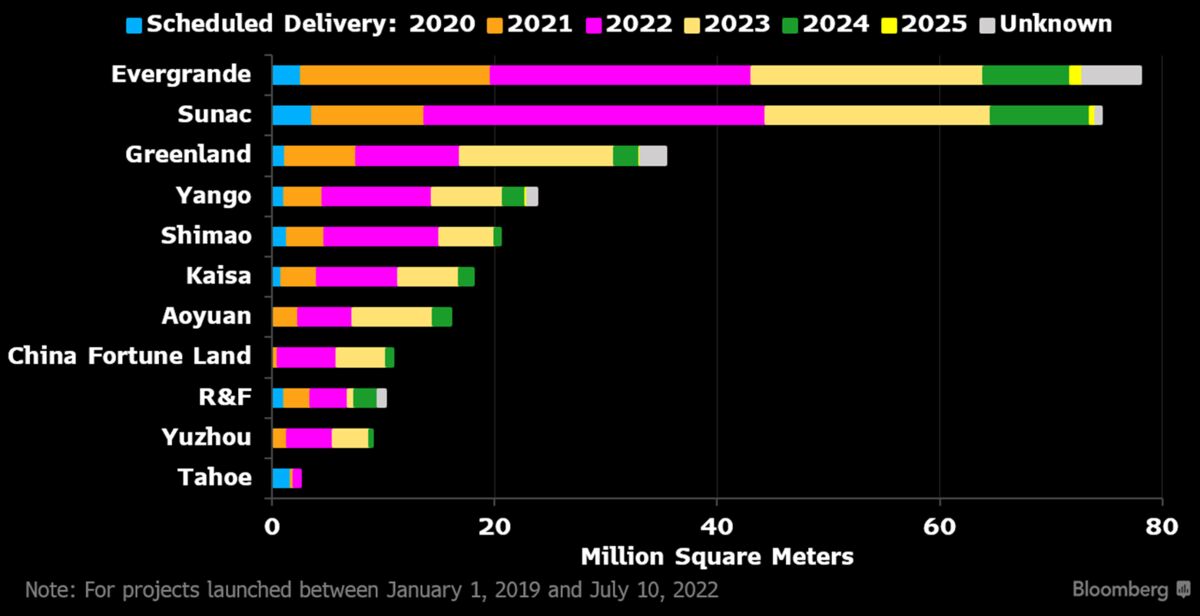
A highly known fact is the massive fall of Evergrande Group in China crippling the huge housing market. It was essentially one of the biggest property developers and contributed to hundreds of projects including massive blocks of buildings. Sadly, they defaulted on their debt and the stock exchange is now trading for pennies on the dollar compared to their previous years. The reason for the collapse is mainly due to the fact that citizens of the country would purchase a part of the multi-story building before it was built. However, the property developers did not finish the building and would use people’s money to begin another construction project. With the new construction project they would then plan buildings and take people’s down payments and continue the ever-ending process of taking home buyer’s money and using it to start new projects. Today they still haven’t finished many of their projects and the Communist Party’s government is working on bailing out the failed property developer giant. Time to highlight some of the reasons this is a major issue in the country:
- New home market accounts for $2.4 trillion dollars
- Existing home market accounts for $52 trillion dollars
- Housing is around 25% of the domestic output
- Chinese citizens hold 40% of their stake in household assets
- Home prices have increased quickly throughout the recent years
- Due to urbanization many homes are newly built
- Newly built homes are sometimes considered Tofu-Dreg projects
- Three Red Lines policy enacted to stop indebted property developers
This entire housing market crash in China escalated mainly in the summer of 2022. Many of the home buyers have threatened to stop paying their mortgage payments for one of two reasons. Either the home is still not built after years of being under construction. The latter reason is the home is built, but it’s considered a Tofu-Dreg project meaning it’s been poorly made. Many of the Tofu projects include leaking roofs, damaged pieces of property, or unfinished products. Personally it’s hard to even think about being in the situation where you dropped thousands of dollars on the home and are actively paying thousands on a mortgage for something that doesn’t exist. Some of these issues arose because homes were being built based on the heavy urbanization in prior decades. Now that most of the rural parts of the country have moved into the city the demand for new buildings has been dropping. The most difficult part for China is knowing that housing accounts for quarter of the domestic output and it’s quickly dying down. Local provinces helped push this Ponzi-Scheme with the property developers as they also made money from citizens making interest payments with the local banks. China’s main government is cracking down on the corruption involved with property developers and the local provinces working together to cause this devastating circumstance. Their main government had to be somewhat aware of this problem back in the summer of 2020 as it created the “three red lines” rules. It knew at least partly that the property development companies were having high debt issues as the rule came into existence. Time to dig into the homes where quarantining was commonplace.
4. Zero-COVID 19 Policy
During the beginning of the COVID-19 pandemic started in Wuhan, China approximately in December or November 2019 they were trying their hardest to control the outbreak. Over a period of time the main government working with the local provinces implemented a zero-COVID policy throughout the whole country. Even if one person tested positive for the virus they would shut down entire blocks of apartments, businesses, manufactures, and streets. Essentially hundreds of millions of people were in lockdowns including 40 cities at a single point in time. Sometimes this would lead to removing individuals from their homes and families forcefully as the country was trying to quarantine everyone. From the numbers received by the country it seems like this effort actually helped curb the spread. The only issue is that there was extreme collateral damage to brands, businesses, and people’s livelihoods in the process. At specific points around a third or 30% of the entire country was under some sort of lockdown. Police were also recorded welding the doors of quarantined buildings so it would be impossible for people to leave their homes. What seemed like it worked in the short run may have actually caused severe consequences for the long haul in China’s history. Let’s look at some factors regarding what happened in the country:
- Strict lockdowns forced citizens to starve and die in their homes
- Lack of medical supplies, food, and necessities caused the population to suffer
- No business in the country caused many of them to shut down permanently
- Weaker effectiveness of the Sincovac vaccine allowed for continuous viral spread
- Non-existing natural immunity caused a wide epidemic when the country opened
- Ten individuals died in an apartment fire during the zero-COVID lockdowns
- Large scale protests began after people died in an apartment fire
As the lockdowns continued for years in the country it waned on the people’s morale. Humans have a natural need to be alive, explore, and interact with each other in communities. Much of this was stripped away leading to civil unrest within cities in the country. Finally, the straw that broke the camel’s back was an apartment fire in November 2022 located in Xinjiang which took the lives of 10 people. The reasons the fire was even able to claim a single life was due to the zero-COVID policies. The firefighters couldn’t get close enough to the building to put out the fire which raged on. After this incident many people took to the streets with organized protests asking for the zero-COVID policies to be abandoned. Some protests even asked for the leaders of the country to step down from power as they were blamed for the policies continued enactment. This was a huge incident in China as it’s a communist led country meaning every citizen who protested had their life on the line. Authority in China exists to the point where anyone who questions the regime risks death, prison, or worse. However, the protests led to China loosening their COVID restrictions from December 2022 to January 2023. It was a great victory for the people in China with many celebrating the wonderful new changes.
New problems emerged after reducing the zero-COVID policy after the surge of protests in the country. They also got a surge of infections from COVID-19 including millions of people infected daily. Some figures even represent 60% of the Chinese population being infected with COVID-19 around December 2022. Fairly important to state that China stopped reporting their COVID related data during the huge spikes which they’re allowed to do as a communist country. Although we don’t really know the numbers of deaths from the virus it’s surely going to be thousands of people losing their lives in the next coming months. Now moving on to the honorable mentions which could have been in this article.
5. Honorable Mentions
Some honorable mentions which were not discussed in-depth include:
- Aging population crises
- Youth’s laying flat movement
- Distrust of the banking system with frozen bank accounts
- Gutter or sewer oil used for cooking
- Angered local countries such as India, Japan, and Taiwan
- Failed investments into neighboring countries known as the belt-road initiative
- Struggling economy after urbanization
- Unused or discontinued large megaprojects
- IUD’s fitted into Uighur Women and forced Uighur sterilizations
Some of the issues listed above could be world-ending for the Chinese communist party. It’s important to note that the country has faced immense hardship in it’s past and hasn’t faltered. Hard times don’t necessarily mean an end, but they do mean that struggle will exist. A few of the honorable mentions directly above will be discussed in future articles. The ones that will be guaranteed covered include the failed large megaprojects, the belt-road initiative, and the aggressive tactics China uses against others around the country.
Conclusion
Every country on deals with difficulties regarding their society, culture, economy, and leadership. As China faces its own demons on the global scale, many will be watching to see it’s rise or it’s demise. In short, China is facing some serious problems right now and it could effect the growth of their country in the coming years. Hopefully the leadership and Chinese citizens could work hard to eliminate each problem and come to peace. The chance of that happening is directly related to the amount of change that can be obtained in each respective area they are failing. The reasons why China should be important to everyone is the fact that globalization is a norm. Countries as a whole have become interdependent on each other due to the incorporation of trading, exports, imports, manufacturing, and production on the global supply chains. Inflation that exists somewhere else can impact the inflation of our own country. It’s crucial to understand what can and may happen to other civilizations to try to mitigate the impact it could have on the United States.